
Key Takeaways (TL;DR)
- Manufacturers who outsource cabinet shop drawings can add drafting capacity without immediately expanding their internal team.
- Cabinet shop drawings provide the dimensions, elevations, configurations, specifications, and the production details needed before manufacturing.
- Outsourcing can help reduce drafting workload, drawing delays, and revision pressure on internal teams.
External drafting support can help manufacturers handle larger and multi-unit cabinet projects more efficiently. - A structured outsourcing workflow covers the project information, drawing development, review, revisions, and then the production-ready documentation.
- Manufacturers should evaluate drafting partners based on cabinet manufacturing experience, 2020 software knowledge, production readiness, scalability, revision management, and communication.
Cabinet manufacturers often manage multiple projects at once, at the same time, and every project needs precise drawings before production can really start. As the workload grows, the internal drafting teams can become stretched between the new designs, the constant revisions, the measurements that have to be spot on. This is where outsourcing the cabinet shop drawings can provide practical support.
Outsourcing cabinet shop drawings can help manufacturers add drafting capacity without adding people right away. When the workflow is set up well, external drafting maintains consistent documentation, improves turnarounds, and gives the production team what they need to move projects forward with fewer delays.
What Does It Mean to Outsource Cabinet Shop Drawings?
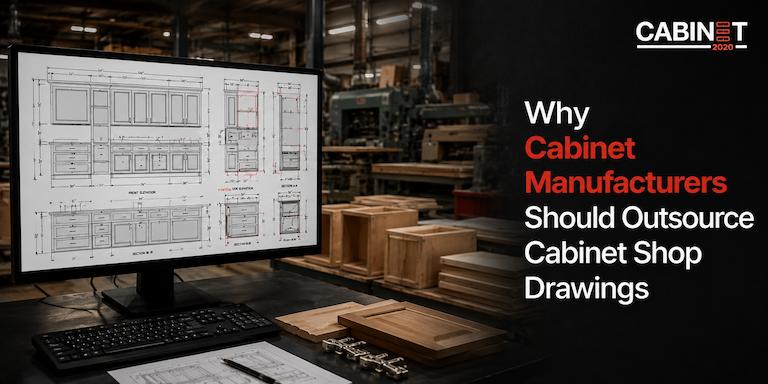
Cabinet shop drawings are detailed production documents used to communicate how cabinets should be manufactured and assembled. They are different from a simple concept or a visual rendering because these drawings concentrate on the technical information needed to move a cabinet idea toward actual production.
When manufacturers outsource cabinet shop drawings, an external drafting team works from the project information the manufacturer gives them. Depending on the project, that can involve floor plans, cabinet layouts, measurements, specification sheets, hardware requirements, and other design details.
What Information Do Cabinet Shop Drawings Include?
The exact documentation varies based on project requirements, but production-ready cabinet shop drawings can include :
- Cabinet dimensions and configurations
- Architectural elevations
- Construction and design details
- Hardware placement
- Project-specific specifications
- Production-related documentation
- Repeated cabinet configurations for multi-unit projects
The goal is to create organized documentation that can be reviewed before manufacturing begins.
Why Should Manufacturers Outsource Cabinet Shop Drawings?
For many manufacturers, the challenge is not simply creating drawings. It is maintaining drafting capacity steady while projects continue to move through sales, design, approval, and then production.
Growing Drafting Workloads
More projects naturally create more drawings and revisions. When the internal drafting team is already handling a full workload, additional projects can create a bottleneck.
Limited In-House Drafting Capacity
Hiring and maintaining a larger internal drafting team may not always match fluctuating project volumes. Outsourcing can provide additional support when the workload increases without requiring the manufacturer to lock in permanent capacity right away.
Tight Project Turnarounds
Cabinet production depends on details being finalized at the right moment. If drawings take too long to complete or revise, they can affect the timings of downstream work
Increasing Revision Requirements
Project changes are normal. Updated measurements, different cabinet layouts, alternative materials, or updated hardware needs can all add extra drafting tasks. External support helps manage this workload alongside the manufacturer’s internal team.
Need for Additional Capacity
Manufacturers with larger projects, multiple kitchens, or multi-unit developments may simply need more drafting coverage than their current staff can handle comfortably. In those cases, cabinet shop drawings outsourcing can help fill the capacity gap.
Key Benefits of Outsourcing Cabinet Shop Drawings
The value of outsourcing is not only about moving drafting work outside the company. It is about creating a more flexible workflow that supports manufacturing operations.
Reduce Internal Drafting Workload
Outsourcing the repetitive or high-volume drafting tasks can reduce pressure on internal teams. This staff can spend more time on production coordination , quality control, project management ,and the customer’s requirements.
Improve Drawing Turnaround
Additional drafting capacity can help manufacturers manage drawing volumes more efficiently. Faster movement from project information to finalized documentation can help keep projects progressing.
Maintain Consistent Production Documentation
Production teams need clear and structured information. Having consistent cabinet manufacturing shop drawings makes it easier to review dimensions, confirmation ,specifications, and other relevant details before production.
Handle More Projects With Existing Resources
Outsourcing can give manufacturers additional capacity when project volume increases. Instead of allowing drafting limitations to determine how many projects the business can handle, an external team can provide support as needed.
Support Large and Multi-Unit Projects
Multi-unit projects often involve repeated kitchen layouts and a high volume of documentation. A structured drafting workflow can help maintain consistency across similar cabinet shop drawings while supporting larger project requirements.
Let Internal Teams Focus on Manufacturing
When the drafting support is done externally, internal teams can focus more closely on manufacturing, production planning, quality checks ,customer communications, and the other core responsibilities.
How Outsourcing Cabinet Shop Drawings Fits Into Manufacturing?
A successful outsourcing workflow should fit into the manufacturer’s existing process rather than create another complicated layer.
1. Share Project Information
The manufacturer shares the floor plan, cabinet layout, measurements, specifications, and the overall project needed to develop drawings.
2. Develop the Cabinet Shop Drawings
The drafting team develops the required documentation based on the supplied project information and agreed requirements.
3. Review the Drawings
The drawings are checked against the project details, so the dimensions, configurations, and specifications can be reviewed before finalization.
4. Make Required Revisions
If changes are identified during review or approval, the drawings can be updated before they move toward production.
5. Finalize Production-Ready Drawings
After the required revisions are complete, the final documentation is prepared for the manufacturing workflow.
6. Move the Project Toward Production
The finalized drawings provide production teams with structured documentation to work from as the project moves into manufacturing.
When Should You Outsource Cabinet Shop Drawings?
There is no single point at which every manufacturer should outsource. The decision usually depends on workload, internal capacity, project requirements, and growth plans.
Outsourcing may make sense when:
- Your drafting team is consistently overloaded.
- Drawing turnaround is slowing projects.
- Revisions are consuming significant internal time.
- Project volumes fluctuate throughout the year.
- You are taking on larger or multi-unit projects.
- You need additional drafting capacity without immediately expanding your internal team.
What Should Manufacturers Look for When Outsourcing Cabinet Shop Drawings?
Choosing a drafting partner requires more than checking whether they can produce drawings. The partner should understand how those drawings fit into a cabinet manufacturing workflow.
Cabinet Manufacturing Experience
Look for experience with cabinet layouts, production documentation, dimensions, configurations, and manufacturing requirements.
Production-Ready Documentation
The drawings should be arranged around real production needs, not just a visual presentation.
2020 Design Software Knowledge
If your workflow uses 2020 kitchen design software, then the drafting partner should understand how that software supports cabinet design, documentation, and project workflow.
Understanding how 2020 kitchen design software fits into the process can also help manufacturers evaluate drafting capabilities.
Revision Management
A clear process for reviewing and updating drawings is important because project requirements can change before production.
Scalable Support
The partner should manage normal workloads and also the times when project volume increases.
Clear Communication
Project information, revision notes, approvals, and the final drawings should move between teams through a straightforward, organized process.
These factors become especially important when manufacturers are evaluating a long-term kitchen design partner to support their existing workflow.
Why Outsource Cabinet Shop Drawings with Cabinet2020?
Cabinet2020 helps cabinet manufacturers, builders, developers, remodelers, and dealers with kitchen design, cabinet drafting, 3D rendering, shop drawings, and estimation services. The workflow is built around 2020 kitchen design software and production-focused documentation.
For manufacturers that need additional drafting capacity, Cabinet2020 provides support for production-ready shop drawings and multi-unit cabinet projects. This allows manufacturers to use an external drafting team as an extension of their existing workflow rather than treating each project as a separate drafting task.
Final Thoughts
For cabinet manufacturers, outsourcing cabinet shop drawings can be a practical way to add drafting capacity, maintain consistent production documentation, and manage changing project volumes without putting additional pressure on internal teams.
The right drafting workflow should fit smoothly into your existing manufacturing process, from project information and cabinet layouts to revisions and finalized drawings. Manufacturers looking for additional support to outsource cabinet shop drawings can explore how our external drafting expertise can complement their existing workflow.
FAQs
Q1. Why should cabinet manufacturers outsource cabinet shop drawings?
Manufacturers often outsource when their internal drafting teams are overloaded, project volumes increase, or drawing turnaround turns into a real bottleneck. External drafting support can add capacity while allowing internal teams to focus on core manufacturing responsibilities.
Q2. What are the benefits of outsourcing cabinet shop drawings?
Key benefits include reduced internal drafting workload, additional capacity, improved turnaround, more consistent documentation, and support for larger, or even multi-unit cabinet projects.
Q3. What information is included in cabinet shop drawings?
Cabinet shop drawings can cover dimensions, elevations, cabinet layouts, construction specifics, hardware placement, product specifications, and other production-related details needed for a project.
Q4. Can outsourcing support large or multi-unit cabinet projects?
Yes. Outsourced drafting can provide additional capacity for projects with repeated kitchen layouts and higher volumes of cabinet documentation, helping manufacturers maintain consistency with project requirements.
Q5. What should manufacturers look for in an outsourcing partner?
Manufacturers should check for cabinet industry experience, production-focused drafting, 2020 software knowledge, revision management, scalability, and clear communication throughout the project.