
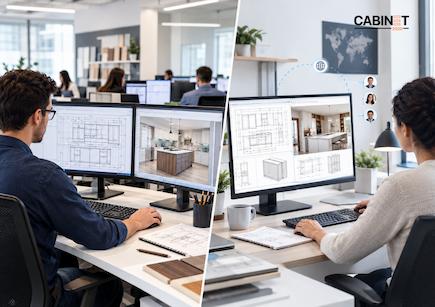
Key Takeaways (TL;DR)
- Cabinet Design Outsourcing adds flexible capacity without the commitment of hiring another full-time designer.
- In-house design works best for businesses with consistent workloads and a need for close daily collaboration.
- Cabinet fits well when you have multiple tasks, uneven demand, or extra rounds of edits. It also helps with drafting and extra overflow work.
- In-house and outsourced design can work together, allowing businesses to keep the core expertise while outsourcing specific tasks.
- The right model depends on workload, cost, turnaround, internal expertise, and capacity needs.
- When you outsource cabinet design, you may get 2D layouts and 3D renderings, along with 2020 Design quoting and estimations.
- Choosing an outsourcing partner required evaluating cabinet industry experience, software expertise, documentation quality, and communication.
- Cost should be evaluated beyond salary, including recruitment, training, software, equipment, and other employee-related overhead.
U.S. cabinet manufacturers, dealers, builders, and remodeling businesses, deciding how to handle design work is not simply a choice between hiring a designer and outsourcing the work.
The best path depends on project volume, turnaround expectations, internal expertise, cost and workflow.
An in-house designer can help when the work stays steady and when close daily coordination matters. Cabinet Design Outsourcing can help more when the schedule swings, project numbers rise, or your in-house team ends up doing too much work that should be handled during production.
What Is Cabinet Design Outsourcing?
Cabinet design outsourcing means assigning some or all cabinet design and documentation tasks to an external design team.
A business might send an entire work to an external team. It might also send only certain steps. Common steps include:
- 2D cabinet layout work
- Cabinet design revisions
- Photorealistic 3D rendering
- 2020 Design-based quoting.
- Shop drawings for cabinets.
- Shop drawings for countertops.
- Cabinet and countertop takeoff and estimates .
- Documentation for multi-unit projects.
The business does not necessarily have to transfer its entire design process. Client-facing choices and day to day project work can stay in-house while the production and document tasks chosen by the company are outsourced.
For manufacturers, 2D layouts can improve production planning by giving teams a structured view of cabinet requirements before production begins.
Cabinet Design Outsourcing vs. In-House Design
No single option wins every time. Each has advantages depending on how a cabinet business operates.
| Factor | In-House Design | Outsourced Design |
| Daily collaboration | Direct interaction | Requires defined communication |
| Company-specific knowledge | Builds naturally | Requires onboarding |
| Capacity | Limited to employees | Can scale with workload |
| Hiring | Recruitment and onboarding required | No direct employee hiring |
| Workload changes | Can create overload or idle capacity | Easier to adjust |
| Internal control | Highest direct control | Managed through processes and reviews |
| Employee overhead | Salary, benefits, equipment, etc. | Service or project-based cost |
| Overflow work | Limited by internal capacity | Additional project support |
| Long-term expertise | Strong internal knowledge | Depends on the relationship |
When In-House Design Works Better
An in-house designer can be the better option when design work is consistent and predictable.
For example, a cabinet manufacturer processing a steady stream of projects may benefit from a dedicated designer who understands its product catalog, construction methods, pricing structure, and internal approval process.
In-house design can also be advantageous when:
- Designers work closely with sales every day.
- Projects require frequent internal discussions.
- The company has a stable year-round workload.
- Product and process knowledge is highly specialized.
- The business wants to build permanent internal expertise.
In these situations, outsourcing does not necessarily need to replace the internal design function.
When Cabinet Outsourcing Design Works Better
Outsourcing becomes more attractive when a business needs flexible capacity rather than another permanent position.
This can happen when:
- Project volume changes significantly.
- Internal designers have a growing backlog.
- Revisions are consuming too much designer time.
The key distinction is simple: hiring adds permanent internal capacity, while outsourcing can add capacity when the business needs it. The business is taking on larger projects.
- Qualified designer recruitment is difficult.
- Additional drafting or documentation support is needed.
- Temporary workload increases do not justify permanent hiring.
Why Do Businesses Consider Cabinet Design Outsourcing?
Cost is one consideration, but capacity and turnaround are often equally important.
1. Mange Design Backlogs
A busy sales pipeline can lead to slowdowns. While in-house staff work on current builds, new clients may still wait for plans, updated drawings, render views, or pricing.
Outsourcing selected tasks can help to reduce that backlog without immediately expanding the internal team.
2. Add Capacity Without Immediate Hiring
Hiring a full-time designer involves more than salary. Businesses may also have recruitment, onboarding, training, equipment, software, and ongoing employee costs.
That investment can make sense when workload is consistently high. When demand is uncertain, outsourcing can provide additional support without building permanent capacity around temporary peaks.
3. Free Internal Designers for Higher-Value Work
Internal designers may spend significant time on repetitive drafting, revisions, documentation, and quote preparation.
Some of these tasks can be delegated while internal staff remain focused on customer discussions, design decisions, product selection, and approvals.
For businesses already using 2020 design software, working with a partner familiar with the software can make this type of delegation easier to integrate into the existing workflow.
4. Handle Fluctuating Project Volume
Cabinet businesses rarely have perfectly consistent workloads. Remodeling contracts, multi-unit developments, seasonal demand, or large projects can create temporary increases.
Outsourcing allows businesses to respond to these changes without treating every workload increase as a reason to hire another permanent employee.
Cost and Capacity: What is The Real Gap?
A financial decision should go beyond comparing an employee’s salary with an outsourcing fee.
An in-house designer can involve:
- Payroll and salary
- Benefits
- Hiring and recruitment
- Training
- Tools, equipment, and software
- Management time
- Paid downtime
- Replacement costs
Outsourcing generally has a different cost structure because the business pays for an agreed service or project rather than maintaining another employee position.
However, outsourcing is not automatically cheaper in every situation. If a business has enough consistent work to keep a full-time designer productive throughout the year, an in-house position may provide better long-term value.
The financial advantage of outsourcing is often stronger when the business needs variable capacity rather than permanent capacity.
| Situation | Potentially Better Fit |
| Consistent full-time design workload | In-house |
| Temporary workload increase | Outsourcing |
| Frequent design backlog | Outsourcing |
| Stable need for internal collaboration | In-house |
| Variable project volume | Outsourcing |
| Permanent product knowledge | In-house |
| Difficult designer recruitment | Outsourcing |
| Additional drafting during peak periods | Outsourcing |
The decision should therefore be based on capacity utilization, not simply the lowest apparent cost.
What Should You Look for in a Cabinet Design Outsourcing Partner?
Once a business decides to outsource, choosing the right provider is important. Price should not be the only selection criterion because cabinet design connects directly with quoting, manufacturing, and installation.
Cabinet Industry Experience
The provider should understand cabinet terminology, layouts, dimensions, revisions, product specifications, and the relationship between design and production.
Software Experience
If your business uses specific software, confirm that the outsourcing team understands the software and can follow your catalogs, standards, file requirements, and quoting workflow.
Production-Ready Documentation
A customer-facing 3D rendering serves a different purpose from a shop drawing used for production.
For manufacturers dealing with increasing documentation requirements, outsourcing cabinet shop drawings can provide additional production support without adding another permanent design position.
Clear Workflow and Communication
Before starting, establish:
- Required project inputs
- Product catalogs and standards
- File formats
- Revision procedures
- Turnaround expectations
- Approval process
- Final deliverables
A structured process reduces unnecessary revisions and makes an external design team easier to manage.
Capacity for Ongoing Support
If outsourcing is intended as a long-term solution, evaluate whether the provider can support normal workloads as well as periods of increased demand.
How to Decide Which Model Fits Your Business
The decision ultimately comes down to the type of capacity your business needs.
Choose or maintain an in-house design team when:
- Workload is consistently high.
- Designers need frequent internal interaction.
- Product knowledge is highly specialized.
- The business wants permanent design expertise.
- Internal capacity can remain consistently utilized.
Consider Cabinet Design Outsourcing when:
- Workload fluctuates.
- Your team has a growing backlog.
- You need additional capacity without another full-time hire.
- Designers are spending too much time on repetitive production tasks.
- Recruitment is taking too long.
- You need support for a specific design or documentation function.
- Projects exceed current internal capacity.
There is also no requirement to make the decision completely one-sided. A company can retain its core internal design function while outsourcing specific production tasks when workload increases.
The important question is whether the current design structure can deliver the required quality and turnaround without creating unnecessary capacity constraints.
Final Thoughts
No one cabinet layout system fits every business. Some companies do well with in-house designers. They can work closely with other teams and build deep product know-how over time. This works best when the workload stays steady and hiring a permanent design group makes sense.
Still, business needs shift. When new projects come up, backlogs grow, or the team gets pulled into production work, it can slow down design output. Cabinet design outsourcing can help in those moments. It adds room to move without forcing an immediate increase in the core staff.
The right partner matters. Look for a firm that understands cabinet workflows, uses the needed software tools, and follows clear documentation rules. You also want delivery that stays accurate and focused on real production needs.
Cabinet2020 supports customers across the USA and Canada with 2D cabinet layouts, 3D rendering, 2020-based quoting, shop drawings, and cabinet and countertop estimation providing additional design and documentation capacity when internal teams need it.
FAQs
Is Cabinet Design Outsourcing better than hiring an in-house designer?
Not in every situation. Outsourcing is often more suitable for flexible capacity, overflow support, or additional production resources. If your business has steady work and you need design help every day with quick meetings, an in-house designer can be a good fit.
What cabinet design tasks can be outsourced?
Businesses can outsource 2D cabinet layouts, 3D renderings, design revisions, 2020-based quoting, cabinet shop drawings, countertop drawings, and cabinet or countertop estimation.
When should a cabinet business consider outsourcing?
Consider outsourcing when design backlogs are increasing, internal designers are overloaded, workloads fluctuate, recruitment is difficult, or additional production capacity is needed without immediately adding permanent staff.
Can outsourced designers work with 2020 Design?
Yes. Businesses should confirm that the outsourcing provider has experience with 2020 Design and can follow their existing catalogs, standards, file requirements, and quoting workflow.
How can a business start outsourcing cabinet design?
Start with one clearly defined workflow or project. Establish the required inputs, deliverables, turnaround, revision process, and approval procedure. A sample project can then help determine whether the external team fits the business’s standards.